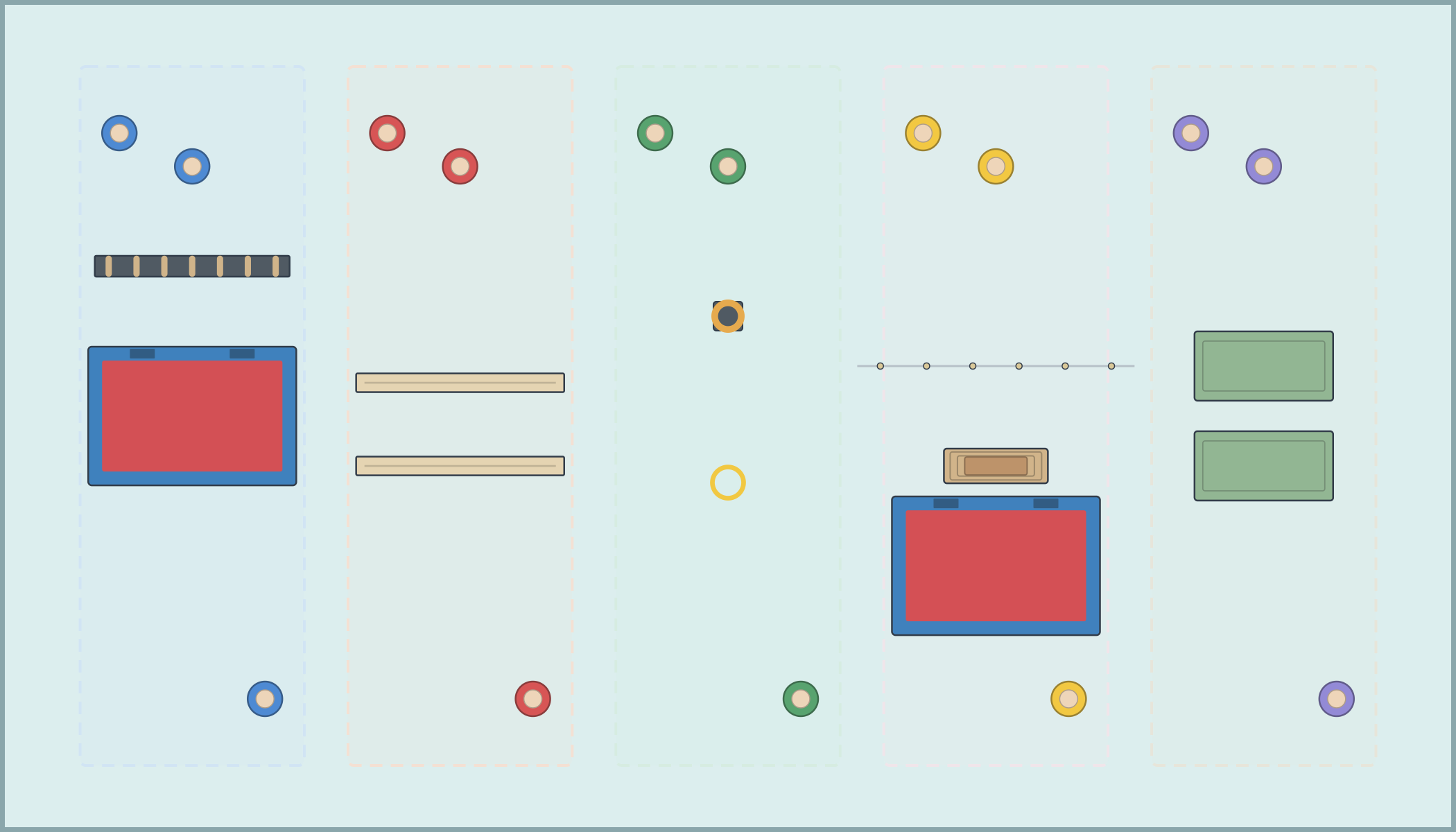
Apparatus
Hoop Course
Work your own way through the row of hoops – only when you have mastered the whole course without errors do you move on to a harder level.
Source: Let's Leap Sports Academy
Ages 4–12 15 min PE hall, Playroom
With your own rope you work step by step from the basic jump to harder jumps such as hopping, crossing and 'the bell'.
Whole hall · 21 × 12 m · 9 items
What you need
Everyone gets their own skipping rope and practises independently, at their own level. Begin with the basic jump: letting the rope swing round calmly and jumping over it with both feet at once, in a steady rhythm. When that goes well, new jump types follow one after another: jumping backwards (for many children actually easier to learn than forwards), hopping on one leg, the switch-foot jump (changing your supporting leg each time), the jumping jack jump, and finally crossover jumping — where you cross your arms and jump through the resulting loop instead of clapping your hands. Whoever has mastered everything may try the hardest jump of all: 'the bell'.
Have a pupil who can do a jump well demonstrate it to the class — that is often more motivating than just your explanation.
The same game has to work for 6-year-olds and 11-year-olds. These are the dials you can turn.
Give a pupil who can't get a jump a different rope — some ropes turn slightly more comfortably because of their weight.
Have advanced pupils combine two jumps, for example backwards on one leg.
Have a pupil who has mastered a jump try it with their eyes closed.
Based on the Dutch national PE curriculum (SLO), this lesson practises the following themes. The goals below belong to phase 3 · ages 9–12.
Swinging on a swing
Moving along with a swing while sitting or standing, to make the swing bigger or keep it going
Hanging swings
Moving along with a swinging apparatus while hanging, to make the swing bigger or keep it going
Free jumping
Taking off to stay in the air for a long time
Vaulting
Taking off to stay in the air for a long time before and/or after placing your hands on a support
Moving to music
Moving to the tempo of the music: matching the tempo and rhythm of your movement to the tempo and rhythm of the music
Performing a dance to music
Performing different movement patterns to music
Source: SLO, Inhoudslijnen primair onderwijs — Bewegingsonderwijs (July 2018). The link with this lesson is a suggestion based on the type of game and the description.
Make sure there is enough distance between the pupils so swinging ropes don't hit each other.
Verified teachers or guests (after approval) — real experiences
Not signed in?
Sign in with your school email address, or continue without an account — a moderator will then check your post before it appears.
Loading reviews…
Work your own way through the row of hoops – only when you have mastered the whole course without errors do you move on to a harder level.
Source: Let's Leap Sports Academy
In four stations you build up from rolling to each other to aiming at a target, throwing against the wall and finally throwing through a hoop at a distance.
Source: KijkZo.nl (Mark & Kirsten Roth-Koch)
Five stations: ladders, table tennis, newspaper throwing, rope climbing and skipping.
Source: Harry van der Meer & Dennis Louter (gymlessenbasisonderwijs.nl)