Cooperative game
Back-to-Back Push
Stand back to back with your partner and try to push them over the line using only your back and legs.
Source: KijkZo.nl (Mark & Kirsten Roth-Koch)
Ages 6–12 15 min PE hall
Challenge someone one or two places above or below you. The winner moves up.
Source: Combinatiefunctionarissen Sport van de gemeente Zwartewaterland
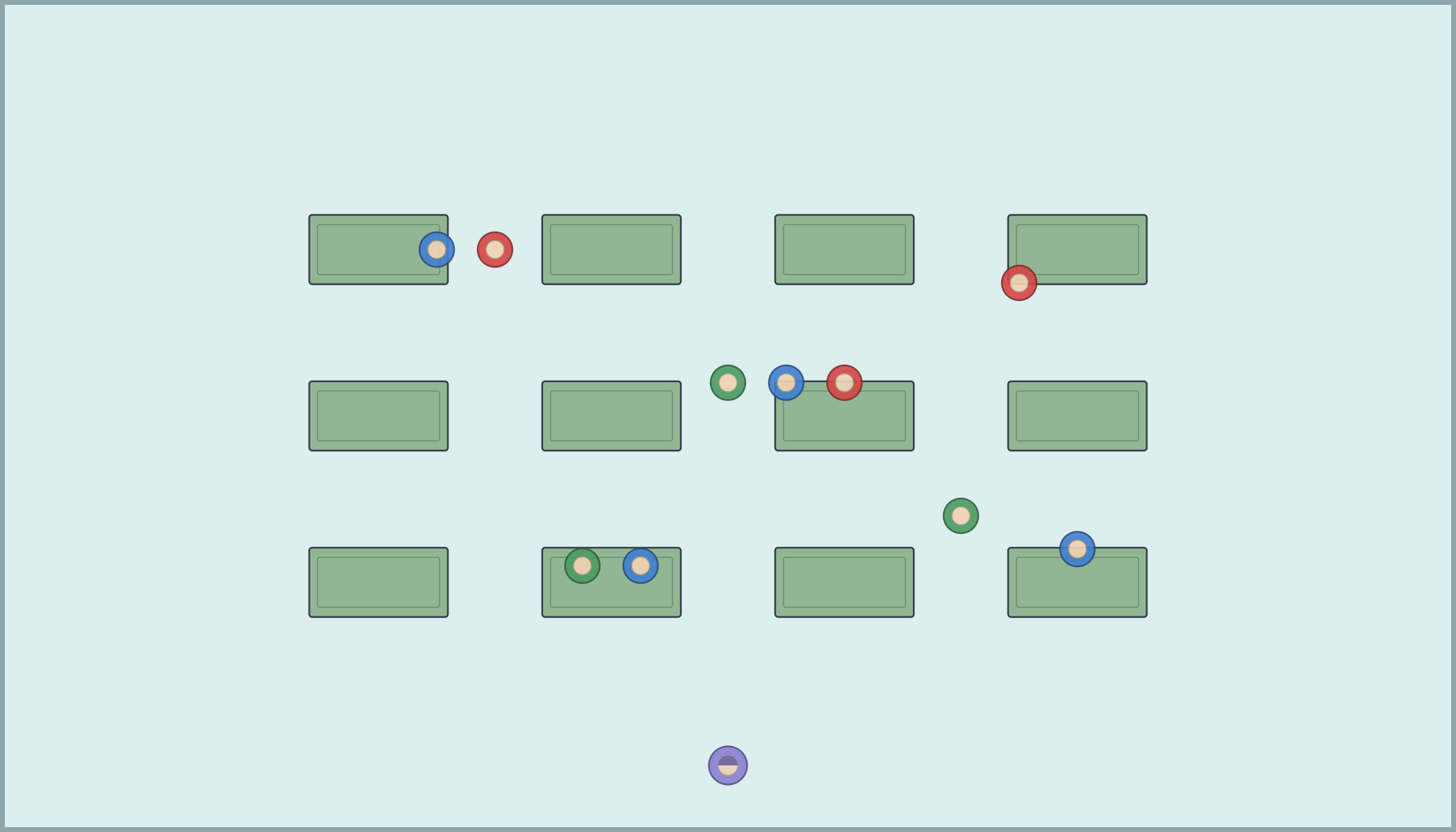
Whole hall · 21 × 12 m · 26 items
What you need
All the name cards lie on the floor like a ladder. You challenge someone who is one or two places above or below you. Together you kneel facing each other, count down from three to zero, and at zero you try to get each other onto your back. Whoever is on their back for three counts has lost. The winner moves up a place, the loser down a place. If you are challenged, you take up the challenge. Because you may only challenge nearby places, you naturally end up with opponents of your own level.
The same game has to work for 6-year-olds and 11-year-olds. These are the dials you can turn.
Challenge only your direct neighbour; the difference in level then stays smallest.
You may challenge up to three places above you.
Play three set rounds and then see who has moved up the most.
Based on the Dutch national PE curriculum (SLO), this lesson practises the following themes. The goals below belong to phase 3 · ages 9–12.
Pushing or pulling an opponent to put them off balance, while they try to stay balanced
Source: SLO, Inhoudslijnen primair onderwijs — Bewegingsonderwijs (July 2018). The link with this lesson is a suggestion based on the type of game and the description.
Ground judo: standing up is not allowed. It must not hurt anybody; anyone who shouts 'stop' is released immediately. In a hold-down, keep your head low near the floor.
Verified teachers or guests (after approval) — real experiences
Not signed in?
Sign in with your school email address, or continue without an account — a moderator will then check your post before it appears.
Loading reviews…
Stand back to back with your partner and try to push them over the line using only your back and legs.
Source: KijkZo.nl (Mark & Kirsten Roth-Koch)
With beanbags gripped between your feet you try to hop them into the hoop, while the rest try to hit you.
Source: Playworks Game Guide
Move around the mats and form a hamburger, milkshake or Big Mac on command.
Source: Combinatiefunctionarissen Sport van de gemeente Zwartewaterland