Cooperative game
Back-to-Back Push
Stand back to back with your partner and try to push them over the line using only your back and legs.
Source: KijkZo.nl (Mark & Kirsten Roth-Koch)
Ages 6–12 15 min PE hall
On '1, 2, 3, go!' you show your fingers — whoever first calls out the total of both hands together wins, and the other runs a lap.
Source: Playworks Game Guide
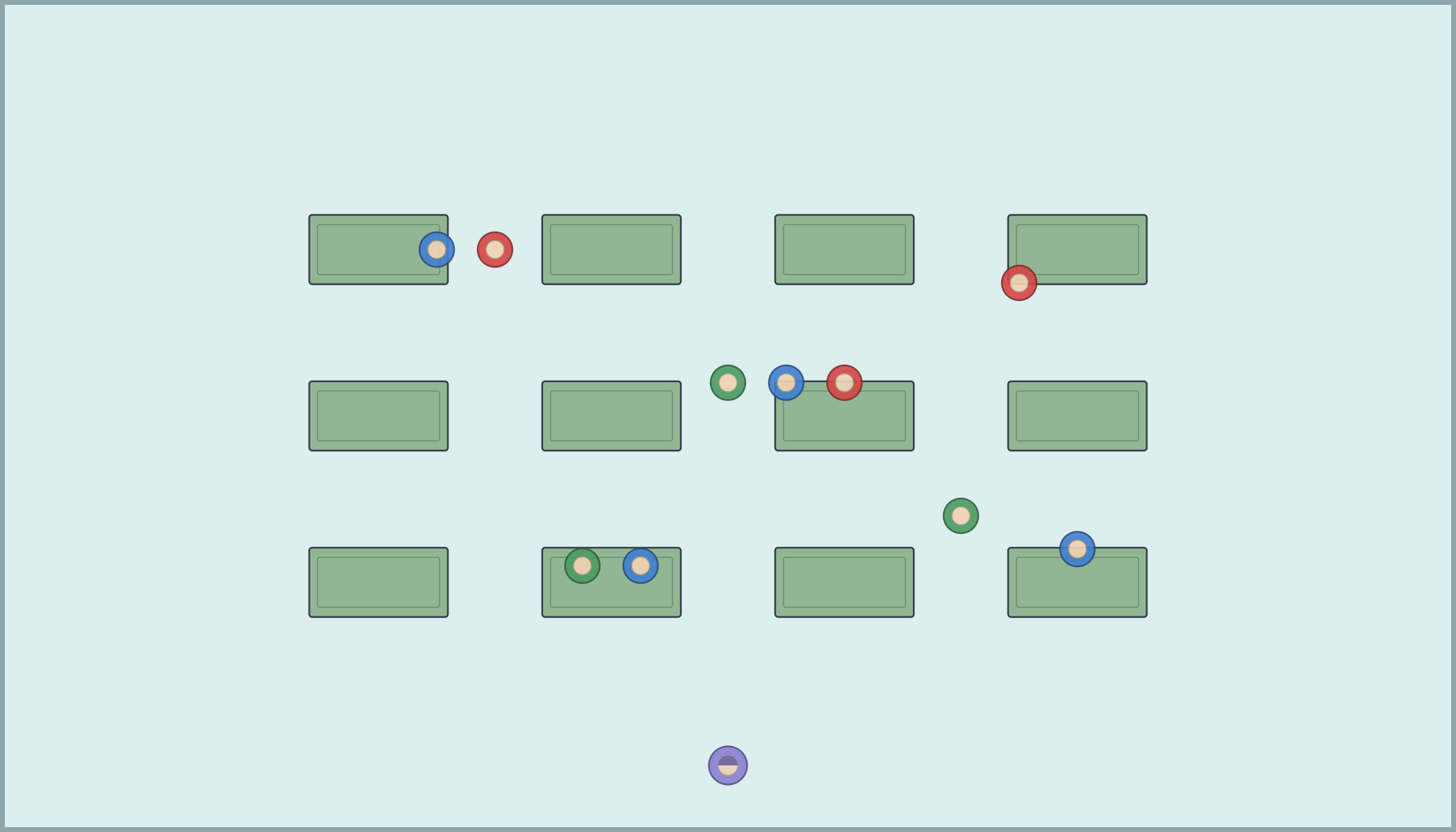
Whole hall · 21 × 12 m · 14 items
What you need
Pairs stand opposite each other with one hand behind their back. On '1, 2, 3 - Go!' everyone brings their hand out with a number of fingers held up. Whoever first calls out the correct total of both hands together wins the round; the other jogs, runs or skips to a designated spot and back. After three rounds you swap partners.
This lesson needs no equipment. Handy when nothing has been set out or you have to move to a smaller room.
Really swap partners after three rounds — that keeps the game fair and prevents the strongest maths pupils always being paired against each other.
The same game has to work for 6-year-olds and 11-year-olds. These are the dials you can turn.
After a few rounds, have older groups multiply instead of add.
Play with groups of three: all three show fingers, whoever first calls the total wins.
Have the loser do a short exercise instead of running a lap.
Based on the Dutch national PE curriculum (SLO), this lesson practises the following themes. The goals below belong to phase 3 · ages 9–12.
Pushing or pulling an opponent to put them off balance, while they try to stay balanced
Source: SLO, Inhoudslijnen primair onderwijs — Bewegingsonderwijs (July 2018). The link with this lesson is a suggestion based on the type of game and the description.
Leave enough space between the pairs so that nobody bumps into anyone else while running.
Verified teachers or guests (after approval) — real experiences
Not signed in?
Sign in with your school email address, or continue without an account — a moderator will then check your post before it appears.
Loading reviews…
Stand back to back with your partner and try to push them over the line using only your back and legs.
Source: KijkZo.nl (Mark & Kirsten Roth-Koch)
With beanbags gripped between your feet you try to hop them into the hoop, while the rest try to hit you.
Source: Playworks Game Guide
Move around the mats and form a hamburger, milkshake or Big Mac on command.
Source: Combinatiefunctionarissen Sport van de gemeente Zwartewaterland