Goal game
Alphabet Basketball
Pass the ball while the class recites the alphabet; whoever holds it at Z gets to take a shot.
Source: Let's Leap Sports Academy
Ages 4–12 10 min PE hall, Playroom
One against one on a small court, with a line instead of a net.
Source: Combinatiefunctionarissen Sport van de gemeente Zwartewaterland
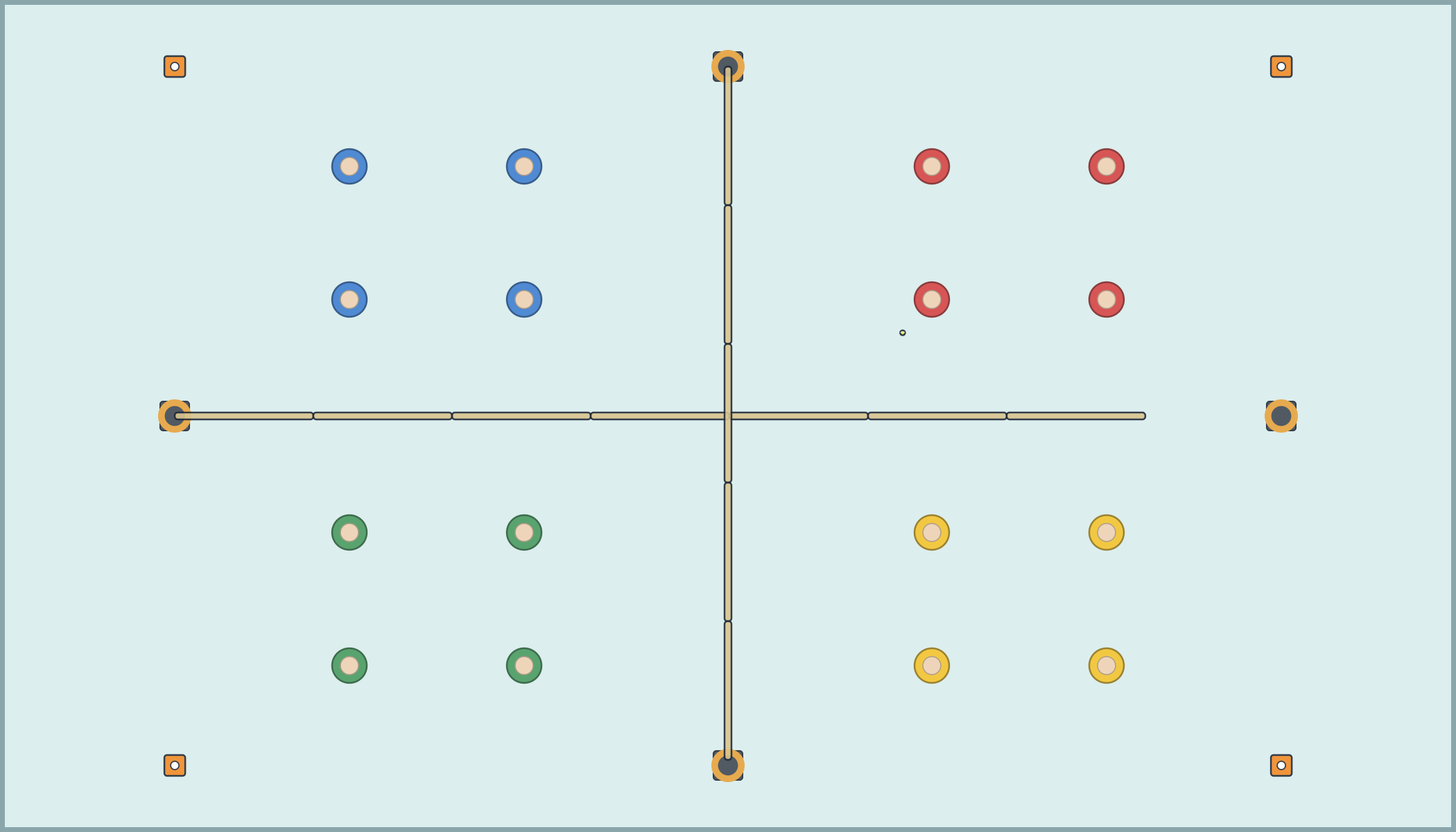
Whole hall · 21 × 12 m · 28 items
What you need
The children play one against one on their own small court; with ten children you therefore need five courts. One of the pair hits the ball directly into the opponent's area. The ball may bounce once, then you hit it back. If it bounces outside the area, the point goes to the other player; if it bounces twice in your own area, it does too. Leaving out the net means many more courts fit in the hall, so everyone plays for the whole lesson.
1. Play as far as possible with the rules the pupils already know when it comes to hockey, football and handball. 2. To get fair teams, the teacher can do the following: at the start of the lesson, have all the children form pairs, with the addition that they should be about equally good at sports. The children can arrange this themselves perfectly well. Have one child of the pair belong to the yellow team and the other child to the other team. 3. This activity is easy to extend with, for example, basketball and/or dodgeball. One condition is that the pupils already know these activities, so that during Multiball they do not have to learn too many new rules. 1, 2 and 3!!
The same game has to work for 6-year-olds and 11-year-olds. These are the dials you can turn.
The ball may bounce twice in your own area.
Based on the Dutch national PE curriculum (SLO), this lesson practises the following themes. The goals below belong to phase 3 · ages 9–12.
Goalkeeper games
Getting a ball past an opponent (the keeper) to hit a target, while the opponent tries to intercept the ball and defend the target
Piggy in the middle
Getting a ball past an opponent (the piggy in the middle) to reach a teammate, while the opponent tries to intercept the ball and win it
Throwing and catching
Playing an object away so that it can be caught
Keeping it going
Keeping an object moving by tapping it
Source: SLO, Inhoudslijnen primair onderwijs — Bewegingsonderwijs (July 2018). The link with this lesson is a suggestion based on the type of game and the description.
Make sure pupils tag with a flat hand and keep their distance from obstacles.
Verified teachers or guests (after approval) — real experiences
Not signed in?
Sign in with your school email address, or continue without an account — a moderator will then check your post before it appears.
Loading reviews…
Pass the ball while the class recites the alphabet; whoever holds it at Z gets to take a shot.
Source: Let's Leap Sports Academy
Four teams, four courts, one shuttle. Whoever makes an error is out; the last team standing wins.
Source: Combinatiefunctionarissen Sport van de gemeente Zwartewaterland
You and the player behind you both try to score first — whoever is quicker stays in the game.
Source: Playworks Game Guide