Athletics
Change of Pace
Jog in a line at a gentle pace — the last person sprints to the front each time and sets the new pace.
Source: Playworks Game Guide
Ages 7–12 10 min PE hall, Outdoors
Sprint, long jump and throwing — and you compare with your own first round.
Source: PELessons.app editorial team
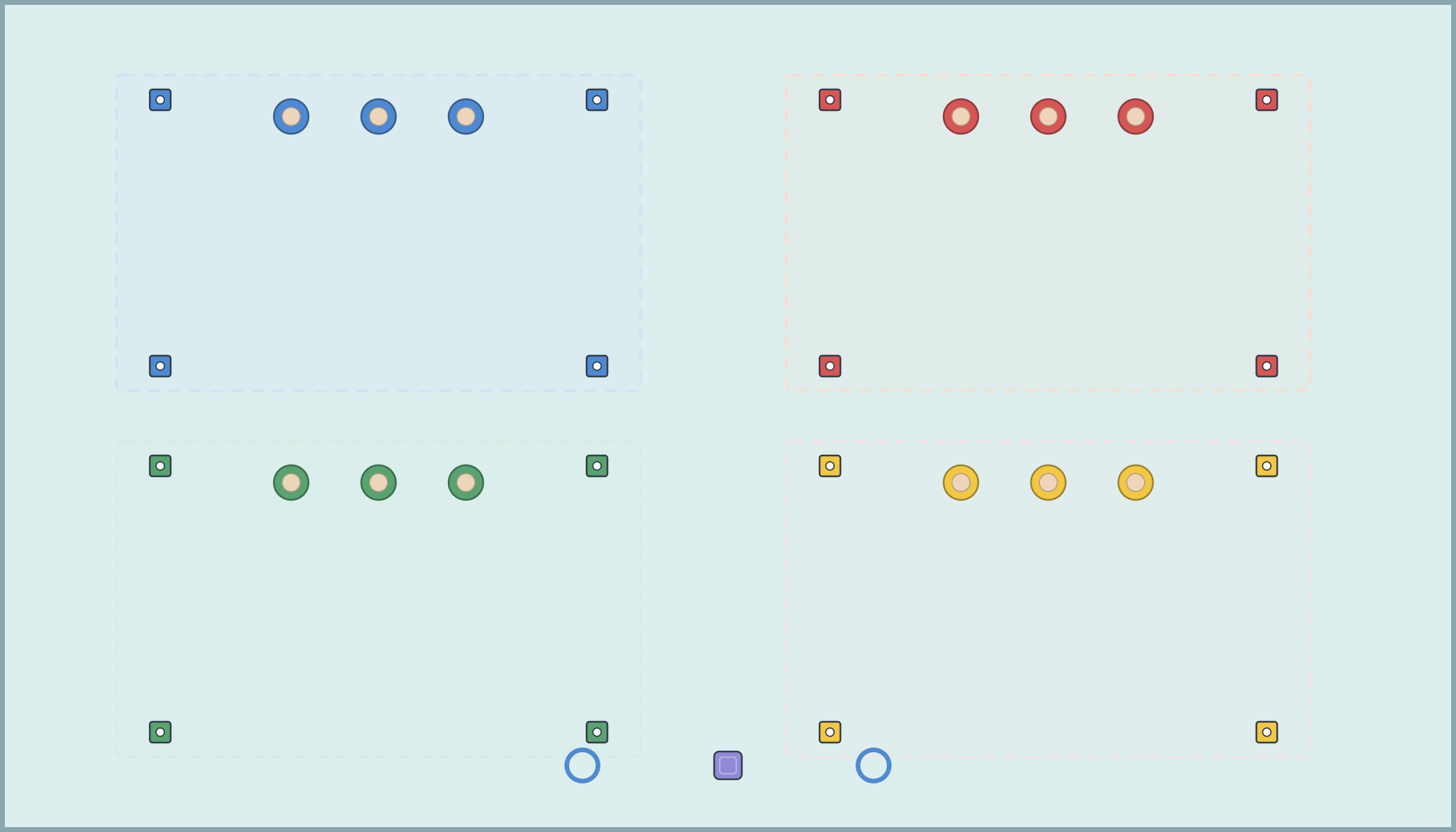
Whole hall · 21 × 12 m · 19 items
What you need
Three stations: a thirty-metre sprint, long jump from a take-off line, and throwing with a beanbag. Pupils note down their own result and try to improve it in the second round. The comparison is with yourself and not with the class, and that makes athletics accessible for pupils who otherwise always finish last. Have them work in pairs: one performs, one measures and records.
Have pupils note their own result and compare only with their first round. A class league table removes exactly the pupils this lesson is meant for.
The same game has to work for 6-year-olds and 11-year-olds. These are the dials you can turn.
Shorten the sprint to twenty metres and measure the long jump from a wider take-off zone.
Sprint with a flying start, or have the run-up for the long jump land exactly on the take-off line.
Note your own result in round one and try to improve it in round two.
Based on the Dutch national PE curriculum (SLO), this lesson practises the following themes. The goals below belong to phase 3 · ages 9–12.
Running to get somewhere as fast as possible
Free jumping
Taking off to stay in the air for a long time
Vaulting
Taking off to stay in the air for a long time before and/or after placing your hands on a support
Aiming
Playing an object away so that it lands in or hits a target as accurately as possible
Throwing and hitting far
Playing an object away as hard and/or as far as possible
Source: SLO, Inhoudslijnen primair onderwijs — Bewegingsonderwijs (July 2018). The link with this lesson is a suggestion based on the type of game and the description.
Provide a clear run-out area after the sprint and a soft landing for the long jump.
Verified teachers or guests (after approval) — real experiences
Not signed in?
Sign in with your school email address, or continue without an account — a moderator will then check your post before it appears.
Loading reviews…
Jog in a line at a gentle pace — the last person sprints to the front each time and sets the new pace.
Source: Playworks Game Guide
Outdoors: running exercises in four coloured squares, then BeeBall.
Source: Harry van der Meer & Dennis Louter (gymlessenbasisonderwijs.nl)
Children practise acrogym shapes in pairs or small groups using 45 cards with stars for the level, from ages 4–6 up to the upper primary years.
Source: KijkZo.nl (Mark & Kirsten Roth-Koch)